
Supply Chain Tech Primer

Every semester, our new member class dives deep into an industry, and our Fall '24 class researched supply chain tech, the startups and trends in the space.
What is supply chain tech?
The Digital Revolution in Supply Chains
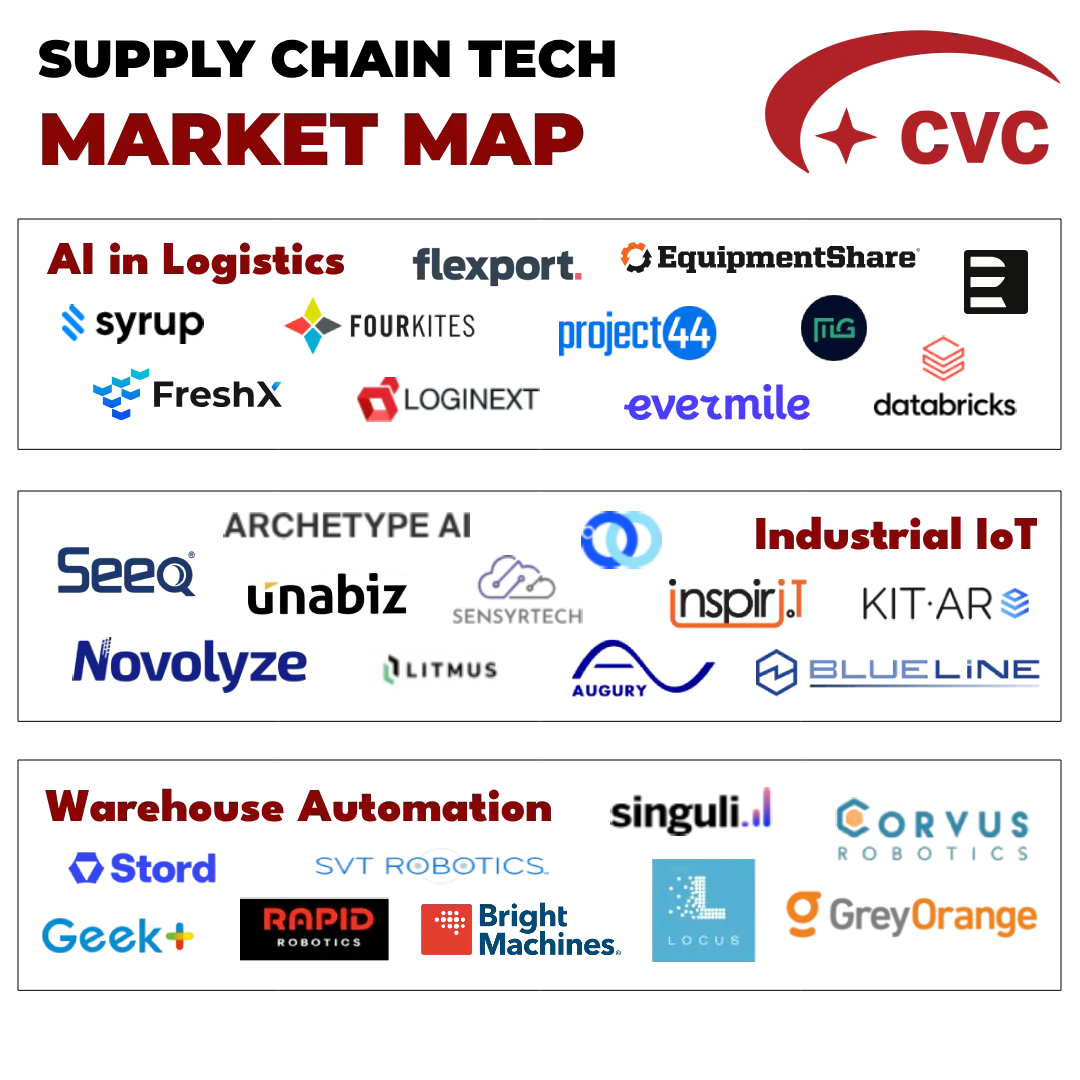
Supply chain technology is transforming how businesses manage their operations, from warehouse floors to global freight networks. This rapidly growing industry encompasses technologies that enhance supply chain efficiency, organization, and resilience. We are highlighting three critical verticals within supply chain tech: industrial IoT, warehouse automation, and AI in logistics.
Industrial IoT: The Connected Factory
Industrial IoT networks are revolutionizing manufacturing and mining operations, with the market projected to reach $41.8B by 2033. Through interconnected sensors and devices, companies can monitor equipment in real-time, predict maintenance needs, and optimize energy usage. Companies like Honeywell and Siemens are leading this transformation, while startups like SigFox are pioneering new approaches to network connectivity.
Warehouse Automation: The Smart Storage Solution
The warehouse automation market, currently at $21.84B, is set to reach $95.45B by 2034. This growth is driven by both physical automation (robots and autonomous vehicles) and digital solutions (management software and analytics). Amazon Robotics and Dematic are pushing boundaries with autonomous robots, while startups like Exotec are introducing innovative vertical storage solutions.
AI in Logistics: The Intelligent Supply Chain
The broader generative AI revolution is driving growth for AI in logistics, which is expected to grow from $4.5B to $157.6B by 2033. Companies like Databricks and Flexport are leveraging AI to optimize everything from demand forecasting to route planning. This technology is helping businesses reduce costs, improve sustainability, and enhance worker safety through real-time analytics and predictive insights.
As geopolitical tensions and regulatory challenges continue to impact global supply chains, these technologies are becoming increasingly critical for businesses looking to maintain competitive advantages and operational resilience in an uncertain world.
Who are the biggest players in supply chain tech?
Deep Dive: Hear from companies innovating in the space
With the issues of labor, demand and supply shocks becoming common for manufacturing, players within the technology space have come in with products aimed at improving processes, cutting costs and improving accuracy. Major players such as Amazon Robotics, FourKites, and Manhattan Associates have been applying analytics, robotics, and real-time visibility stamps in AI-powered systems showing the importance of being able to scale and integrate seamlessly with other systems in place. This section focuses on GatherAI in the Warehouse management space, and Rapid Robotics in the Industrial IoT Space.
Gather AI employs drones equipped with computer vision and artificial intelligence in order to automate warehouse inventory processes. As a result of their technology, drones are capable of autonomously scanning an inventory of more than 900 pallets per hour. Drones supply data insights to a web dashboard, offering a reduction in manual labor by 87% and an enhanced productivity level in several other instances.
Gather AI was established by a group of Carnegie Mellon alumni and focuses on applying AI to analyze bar codes, text and spatial data. This concept provides a great opportunity for more information, such as inferred case counts and space utilization metrics, which allow for more effective use of space and ensure fewer mistakes when handling inventories. The organization has emerged as a key player by realizing a 5 times increase in productivity and 66% reduction in database errors. Its use by such major logistic providers as NFI and GEODIS show its importance in addressing real world problems.
Rapid Robotics focuses on offering robotic tools tailor made for the manufacturing working environment. Their robots are designed to be plug-and-play, requiring minimal setup and programming, which lowers the barrier for adoption in small to medium-sized businesses. The company’s primary focus are repetitive tasks that are usually very labor intensive and very expensive to hire people for, such as assembling and packaging.
Rapid Robotics has built a range of customers covering food processors and electronics manufacturers by providing cheap and easy to use robotics. Their approach of making robotics accessible conforms to the current trend of making advanced automation available in mainstream market segments that are currently underserved.
Both Gather AI and Rapid Robotics are clear illustrations of the change towards adaptable, affordable and AI led robotics in the supply chain and automobile industries. Gather AI is distinctive due to its deployment of self-driving drones that provide remarkable details on inventory and efficiency. Rapid Robotics focuses on deploying low-cost user-friendly robotics in small and medium enterprises, a niche market largely ignored by expensive automation manufacturers.
By: Sam Shridhar, Nihaal Konda, Sasha Masson and Jenny Chen